An Attorney's Advice for Creators at IMCX 2026: Contracts, Disclosures and Saving Your Receipts
Spencer Fane attorney Alex Baker walked creators, agencies and brands through the legal risks that trip up influencer deals.

The Creator Economy
Editorial oversight by the Editor-in-Chief
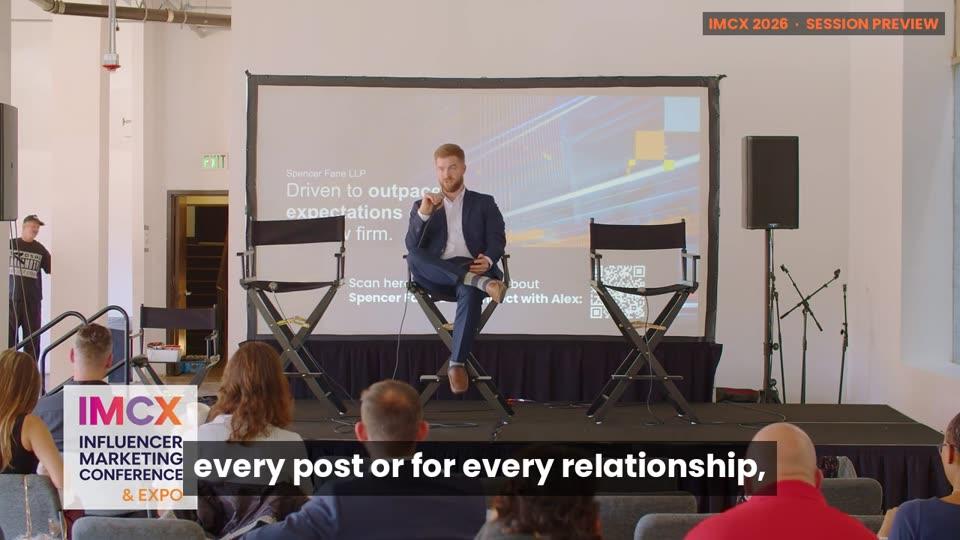
At IMCX 2026 in Los Angeles, Alex Baker, an attorney at Spencer Fane, led a session on influencer marketing and advertising law. The focus was practical: where deals go wrong, who ends up holding the bag, and what creators and agencies can do before a problem starts.
This article summarizes general points from the session and is not legal advice.
There is no perfect checklist, but there should be a process
"There is no magic perfect checklist for everyone to go through," Baker said. What matters is having a consistent process. For talent agencies in particular, a standard review process for every post or every relationship "bodes well," he said, when something goes wrong.
Watch for stacked contracts
One risk Baker flagged is that many influencer deals involve more than one contract. A brand may sign with a talent agency, and that agency signs a separate agreement with the influencer. Those contracts often have different indemnification clauses or different language about who is covered in which situations.
When something goes wrong, Baker said, the result is often the Spider-Man meme: "Everyone's pointing the finger and no one wants to take responsibility." Reading both layers of the deal, and making sure they line up, is one of the simplest ways to reduce that risk.
When a platform changes the rules after the fact
During audience Q&A, a creator described a live-streaming platform changing its rules and then penalizing activity that happened before the new rules existed. Baker noted that situations like that may warrant talking to an attorney, and that if it affected many creators at once, it could potentially develop into a class action, depending on the facts.
His bottom-line advice: every claim comes down to whether you were actually harmed. "Everything comes down to proving that you've been harmed in some way," he said. "So save your receipts."
Negotiate, don't just sign
Baker also reminded creators that a brand contract is an agreement between two parties. "If you feel like there's something you don't like in there, then you can bring it up," he said. "It's not like you have to accept the first contract that they slide over to you."
The takeaways
- Build a repeatable review process for every post and partnership
- Read every contract in the chain, not just your own, and check that indemnification lines up
- Document everything, especially income affected by platform changes
- Treat brand contracts as negotiable
**Watch the 1-minute preview** of this session, and every IMCX 2026 session, at [influencermarketingexpo.com/sessions](https://influencermarketingexpo.com/sessions/). IMCX returns to Los Angeles on May 19-20, 2027, and [free registration is now open](https://influencermarketingexpo.com/tickets/).

By The Creator Economy Editorial Team
Editorial oversight by Ismail Oyekan
Ismail Oyekan is the Editor-in-Chief of The Creator Economy and the founder of IMCX (Influencer Marketing Conference & Expo), the premier industry gathering connecting creators, brands, and capital. Named one of the 100 Most Influential People in Influencer Marketing by Influence Weekly, he has managed over $20 million in influencer marketing budgets and worked with A-list talent including Floyd Mayweather and DJ Khaled. He is a sought-after advisor to creator economy startups.