OpenAI Bought TBPN. HubSpot Bought Starter Story. Plaid Bought a Creator Fintech. The Consolidation Wave Is Real.
Three high-profile creator-economy acquisitions in early 2026 mark a phase change. The independent creator-economy startup era is closing. The strategic absorption phase is starting.

The Creator Economy
Editorial oversight by the Editor-in-Chief
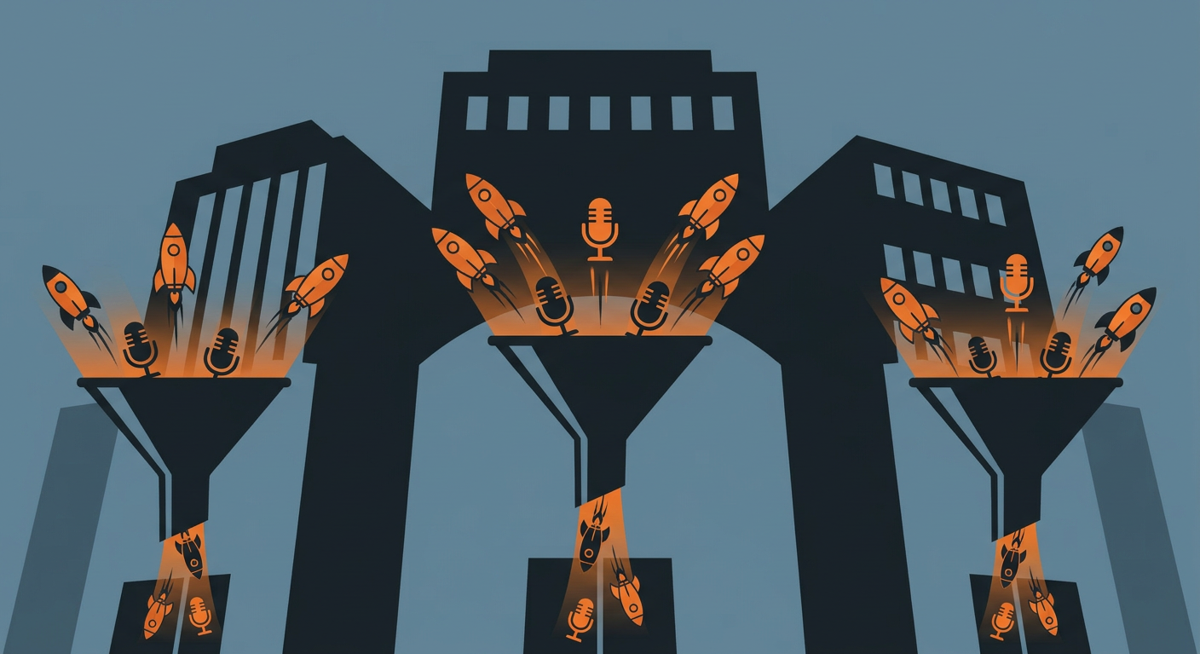
The early-2026 deal flow tells a clearer story than any single acquisition would. OpenAI acquired TBPN, the creator-led tech podcast that had become one of the most influential voices in AI commentary. HubSpot acquired Starter Story, the creator-built media business that had spent six years building an audience of small-business operators. Plaid acquired a fintech creator platform, expanding its banking infrastructure into the creator-payments stack. Three deals, three distinct buyer rationales, one underlying pattern: large strategic acquirers are absorbing creator-economy assets at a pace and at price points that signal the consolidation phase has begun.
The independent-startup era of the creator economy — the 2018-to-2024 period when dozens of small companies built creator-adjacent tools, hoping to either scale into stand-alone businesses or get acquired at favorable multiples — is closing. What replaces it is a phase where strategic acquirers, mostly large tech and fintech players, accumulate creator-economy capabilities through M&A rather than internal product development.
What Each Deal Signals
OpenAI buying TBPN is the most thesis-revealing of the three. TBPN is not a software company; it's a media business. The creators behind it built an audience of AI operators, founders, and investors through a podcast and adjacent content. OpenAI's acquisition is not about technology, customer base, or revenue — it's about narrative infrastructure. OpenAI is buying a media property because owning the dominant AI podcast is an asset that's more valuable to OpenAI than it is to the open market.
The implication is that the largest AI companies have started treating media properties as strategic assets, the same way they treat compute, talent, and data. This is a meaningful shift. It mirrors the early-2010s pattern where social platforms started treating content as a strategic asset and began buying media companies and creator businesses to lock in audience.
HubSpot buying Starter Story is a different read. HubSpot is a CRM and marketing-automation company; Starter Story is an audience of small-business operators in HubSpot's ICP. The acquisition is a customer-acquisition play disguised as a media acquisition. HubSpot didn't need a podcast or a newsletter; it needed durable, loyal access to the audience that buys HubSpot. Starter Story's value is the audience pipeline, and HubSpot can monetize that pipeline at a unit economics that justifies an eight-figure acquisition price.
This deal pattern — SaaS companies buying creator-built media properties as customer-acquisition assets — is going to recur. The math works whenever a creator's audience overlaps materially with a SaaS company's ICP, and the audience is large enough that the implied customer-acquisition cost is favorable compared to paid alternatives.
Plaid's acquisition of the creator-fintech platform is a third pattern. Plaid is building horizontal infrastructure across financial services, and creators are an increasingly significant customer segment for that infrastructure. The acquisition adds creator-payment capability to Plaid's stack and ensures Plaid is positioned to capture creator-payments market share as the segment grows. This is a defensive consolidation move — Plaid acquiring before the creator-payments space matured into a competitor.
The Pattern: Big Tech Buying Creator-Adjacent Tools
Each of these three acquisitions fits a different sub-pattern, but they collectively express a thesis: large incumbent tech companies have decided that creator-economy capabilities are easier to buy than to build. This is partly a function of the maturity of the creator-economy startup ecosystem. There are now enough successful creator-economy companies — with real revenue, real customer bases, and real operational expertise — that strategic acquirers can pursue M&A rather than internal product development.
It's also a function of timing. AI is forcing strategic accumulation across multiple categories. Companies that don't acquire ahead of the AI-driven product compression face the risk of having their internal products obsoleted by AI-native alternatives that emerge from outside their organization. Buying creator-economy companies ahead of that compression is a way to lock in capabilities at favorable prices.
For the creator-economy startups still operating independently, this is a mixed signal. The good news is that exit paths are real and the buyer pool is more diverse than it has been historically. The hard news is that the era of building toward a long-term independent business is closing, because the strategic acquirers have decided the category is worth absorbing rather than competing with.
What Gets Acquired Next
The deal patterns of early 2026 suggest several specific categories where acquisitions are likely to accelerate.
Creator-payments and creator-fintech tools are now in active strategic accumulation by Plaid, Stripe, and likely Adyen. Any independent company in this category should be calibrated for an acquisition outcome within 18 months.
Creator-audience SaaS — products that help brands manage influencer relationships — is likely to be consolidated by HubSpot, Salesforce, and adjacent CRM platforms. The Starter Story acquisition was a media-asset deal, but the same buyers will look at influencer-CRM tools for the same strategic logic.
Creator-content infrastructure — production, editing, distribution tools — is probably the next AI-driven acquisition wave. OpenAI, Anthropic, and possibly Adobe are likely buyers of category-leading content tools that have meaningful creator user bases.
Creator marketplaces — platforms that connect brands and creators — are vulnerable to consolidation by performance-marketing platforms. Meta, Amazon, and TikTok are all logical acquirers.
What It Means for Independent Founders
For founders building in the creator economy in 2026, the strategic implication is to plan for an acquisition outcome rather than an IPO outcome. The IPO path for creator-economy companies has been narrow and unforgiving. The M&A path is now broader and more reliable. Building toward strategic accumulation by a clearly defined buyer pool — naming the likely acquirers explicitly in fundraising and product decisions — is increasingly the right operational frame.
This doesn't mean abandoning the long-term-independent path. Some companies will execute well enough to remain independent at scale. But the base-case outcome for category-leading creator-economy companies is now strategic acquisition, and founders who plan accordingly will optimize for the kinds of strategic value — proprietary data, defensible audience, capability gap-filling for incumbents — that drive premium acquisition prices.
What It Means for Creators on Those Platforms
The harder read is for creators whose businesses depend on platforms that get acquired. Creator economics post-acquisition can shift in either direction — sometimes acquirers invest more heavily in the acquired platform, sometimes they reduce investment as the platform is absorbed into a larger product. The defensive posture for creators is the same posture that has been recommended for years: own your audience, diversify your platforms, treat any single platform as a distribution channel rather than a foundation.
The acquisitions of 2026 are validating the strategic logic that's driven creator behavior since the TikTok regulatory uncertainty of 2024 and 2025: the platform you're on today may not be the platform you're on in two years. Build accordingly.
The consolidation wave is real. It's accelerating. The independent creator-economy startup era is closing. Whether that's good or bad depends on which side of the table you're on — but the structural shift is happening, and operating as if it isn't will leave creators, founders, and investors caught flat-footed.
For full context on market sizing and where capital is flowing in the creator economy right now, see the /post/the-state-of-the-creator-economy-2026 report. To explore which independent tools and platforms are still standing, browse the /directory. And for founders and operators tracking these M&A trends, the /influencer-marketing-infrastructure-index provides the infrastructure lens that makes sense of the consolidation.

By The Creator Economy Editorial Team
Editorial oversight by Ismail Oyekan
Ismail Oyekan is the Editor-in-Chief of The Creator Economy and the founder of IMCX (Influencer Marketing Conference & Expo), the premier industry gathering connecting creators, brands, and capital. Named one of the 100 Most Influential People in Influencer Marketing by Influence Weekly, he has managed over $20 million in influencer marketing budgets and worked with A-list talent including Floyd Mayweather and DJ Khaled. He is a sought-after advisor to creator economy startups.